The Arab Center for Dispute Resolution (ACDR) approved by ICANN to become the 5th UDRP provider

The Arab Center for Dispute Resolution (ACDR) was approved by ICANN on the 18th of May to become the 5th UDRP provider. ICANN just published the agenda of the Regular Meeting of the ICANN Board that was held last Saturday.

ICANN had received a proposal from the Arab Center for Domain Name Dispute Resolution (ACDR) in September 2010 to be recognized as one of the official dispute resolution providers under the UDRP. In October 2010 ICANN had requested comments to be submitted on the ACDR proposal and then again ICANN requested comments this March on a a revised version of the proposal. Several comments were submitted and most of the comments were against adding a new UDRP provider, and the official ICANN report reflects that, but that didn’t stop ICANN to do what was planned: to approve the ACDR proposal. Comments were made by George Kirikos, Nat Cohen, Kristina Rosette, Phil Corwin of ICA, Morgan Linton, Kathryne Badura, Steve DelBianco, H SAJM. I asked for a 1 week comment extension period but my request was not considered.

ACDR has produced a further revised proposal addressing a final issue raised in the 1 March 2013 public comment forum but this version has not yet been made available to the public. ICANN prepared a briefing paper and that will also be publicly posted. ICANN claims that the revised ACDR proposal meets the suggested elements as set forth in Information Concerning Approval Process for Dispute Resolution Service Providers.

The Board approved the application of ACDR to become a UDRP provider, and advised the President and CEO, through the General Counsel’s Office, to enter into discussions with ACDR regarding the process for ACDR’s provision of UDRP services.

ICANN also said that the approval of the first UDRP provider located in the Middle East enhances ICANN’s accountability to the Internet community as a whole, enhancing choice for UDRP complainants. Here is how ICANN and ACDR handled the public comments:

“Some of the comments in opposition addressed issues such as the level of fees, which is fully within the ACDR’s purview. Other commenters suggested that ICANN develop contracts with each of its UDRP providers as a means to require uniformity among providers. Contracts have never been required of UDRP providers. On the issue of uniformity among providers, however, the ACDR’s proposal does two things: first, highlighted areas where risk of non-uniform conduct was perceived (such as issues with commencement dates and definitions of writings) have been modified; second, the proposal now includes an affirmative recognition that if ICANN imposes further requirements on providers, the ACDR will follow those requirements; third, the ACDR has revised a specific portion of its Supplemental Rules that was highlighted by commenters as a potential risk to uniformity. This is a positive advancement and helps address concerns of ICANN’s ability to, in the future, identify areas where uniformity of action is of its obligation to abide by ICANN modifications that could enhance uniformity among providers.”

The ACDR is jointly established by the Arab Intellectual Property Mediation and Arbitration Society (AIPMAS) and the Arab Society for Intellectual Property (ASIP), with headquarters in Amman, Jordan and additional offices in other Arab Countries. Both the AIPMAS (established in 1987) and ASIP promote the activities of the Arab Center of Mediation and Arbitration, established in 2003, active in resolving conflicts related to intellectual property through international arbitrators. The ACDR will be the first Approved UDRP Dispute Resolution Service Provider headquartered in an Arab state.

The current 4 active UDRP providers are:

Asian Domain Name Dispute Resolution Centre
National Arbitration Forum
The Czech Arbitration Court Arbitration Center for Internet Disputes
WIPO – World Intellectual Property Organization

WIPO stats for Q1 2013: UDRP complaints down, average number of domains per case up, .com domains 62% of cases

I checked the WIPO stats for the 1st quarter of 2013 and found that UDRP complaints have slowed down while the average number of domain names per case has increased.

Usually the first 2 quartes of the year have the most UDRP complaints filed but Q1 2013 had the lowest number of complaints of all 2012 quarters.

2012 2013
Q1 763 651
Q2 762
Q3 658
Q4 701

2013 started with a lot of complaints but it gradually ended up to one of the lowest numbers for March ever.

2012 2013
January 192 251
February 271 216
March 300 184

The average number of domain names per case has gone up significantly reaching more than 3 domain names per case in 2013:

Year Average Number of Domain Names per Case
1999 1.00
2000 2.02
2001 1.58
2002 1.69
2003 1.61
2004 2.21
2005 2.27
2006 1.54
2007 1.64
2008 1.70
2009 2.22
2010 1.62
2011 1.73
2012 1.76
2013 3.06

In 2012 75% of the domains were .com while in 2013 the number has dropped to 62%. .Net, .org and .info have seen great increase:

2013
.com    1417    61.64%
.net    327    14.22%
.org    269    11.70%
.info    228    9.92%

2012
.com    3475    74.84%
.net    487    10.49%
.org    322    6.94%
.info    264    5.69%

There has not been a single .xxx UDRP complaint in WIPO in 2013 after 16 complaints in 2012.

In ccTLDs .nl lost first place to .co and that shows the growing popularity of the .co.

2013
ccTLDs    Number of Domain Names
.co    21
.nl    20
.es    15
.au    13
.mx    11

2012
ccTLDs    Number of Domain Names
.nl    103
.au    55
.es    53
.ch    53
.co    47

While the percentage of the denied complaints is pretty much stable, the percentage of cancelled domains has decreased even more:

2013
Outcome Number of Cases Percentage
Cancellation 2 0.88%
Transfer 206 90.35%
Complaint denied 20 8.77%
2012
Outcome Number of Cases Percentage
Cancellation 64 2.84%
Transfer 1985 88.07%
Complaint denied 205 9.09%

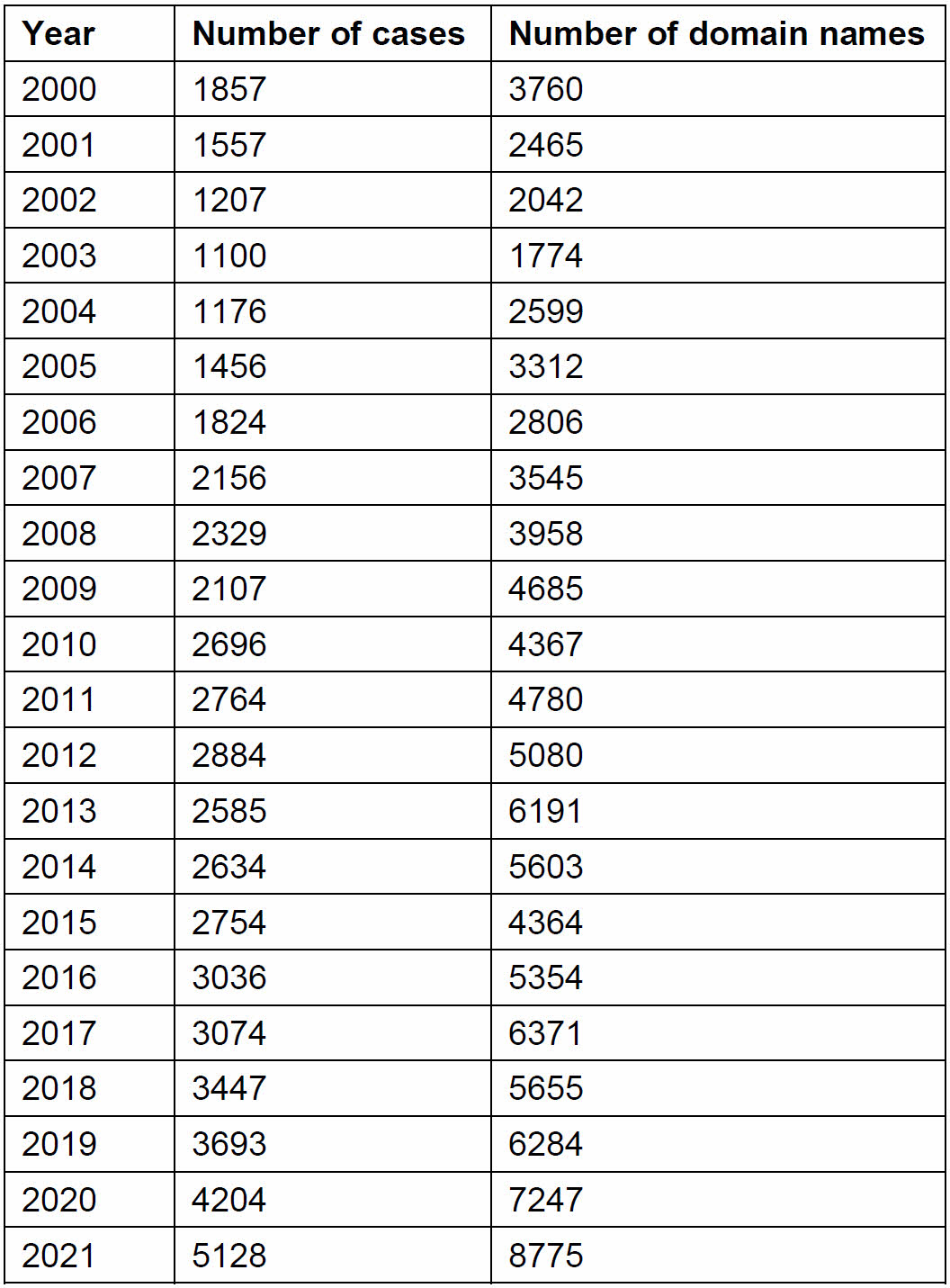
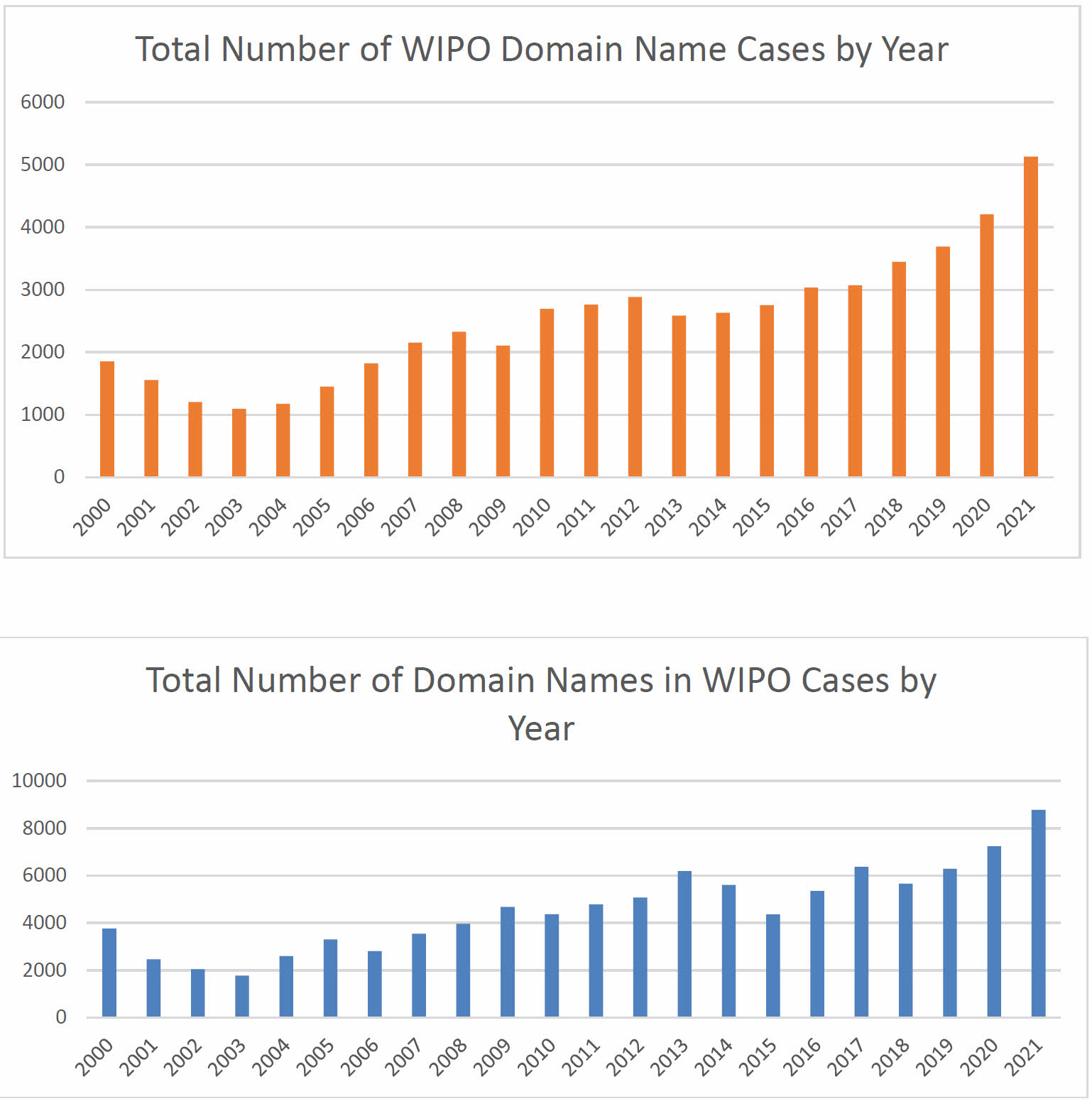
The WIPO Arbitration and Mediation Center published its 2012 review on “Internet Domain Name Dispute Resolution”. In 2012, trademark holders filed a record 2,884 cybersquatting cases covering 5,084 Internet domain names with the WIPO Center under procedures based on the Uniform Domain Name Dispute Resolution Policy (UDRP). This represents an increase of 4.5% over the record established in 2011.

Procter & Gamble buys the domain Swash.com from Marchex after found guilty of RDNH

Archeo (Marchex) announced its Q1 domain sales today with $1.4 million from 50 domains sold for an average $27,233. Archeo published the top 20 sales of the quarter and the number 1 spot was taken by Swash.com that was bought by Procter & Gamble.

Procter & Gamble was found guilty of Reverse Domain Name Hijacking as Marchex’s Swash.com was saved in UDRP. Procter & Gamble lied to the WIPO Panel and tried to cheat it’s way into stealing the domain name  Swash.com but the company was outed by the Complainant and the 3 member Panel that denied the complaint.

Procter & Gamble tried to steal the domain name by paying only 5-10K USD in UDRP and lawyer fees but that backfired. The company probably ended up paying a lot more than if it hadn’t filed for that UDRP complaint. I am sure that Marchex understood how desperate Procter & Gamble was for the domain and doubled its price and of course added all the UDRP response cost. Procter & Gamble probably paid mid 6 figures for the domain Swash.com. Lesson learned.

UDRP complaints hold steady at the National Arbitration Forum: 2,060 UDRP cases filed in 2012

The National Arbitration Forum (FORUM), an international provider of dispute resolution services, today announced that a total of 2,060 cases were filed in its domain name dispute resolution program in 2012, down 22 cases from the 2,082 it received in 2011. The FORUM is approved by the Internet Corporation of Assigned Names and Numbers (ICANN) to provide domain name dispute resolution services under policies like the Uniform Domain Name Dispute Resolution Policy (UDRP).

The WIPO Arbitration and Mediation Center announced 2 weeks back that it handled 2,884 UDRP complaints in 2012 seeing a 4.5% increase from 2011.

In 2012, the FORUM surpassed a total of 20,000 domain name cases filed since it accepted its first case in 1999. The FORUM was approved as a UDRP Provider for disputes involving .pw, the country-code TLD for Palau.

About the National Arbitration Forum (FORUM) Based in Minneapolis, Minnesota, United States, the National Arbitration Forum is an approved provider of the Uniform Dispute Resolution Policy (UDRP) by the Internet Corporation of Assigned Names and Numbers (ICANN). Since 1999, more than 20,000 domain name disputes worldwide have been filed through the National Arbitration Forum’s state-of-the-art case management system. For more information, visit http://domains.adrforum.com/.

Avaya Inc. found guilty of Reverse Domain Name Hijacking and harassing the domain name owner

Avaya Inc., a multinational company with over 17,500 employees worldwide, was found guilty of Reverse Domain Name Hijacking by a 3-member Panel at the National Arbitration Forum. I represented the Respondent, Avayo Electronics, in these proceedings.

Avaya Inc. tried to steal the domain name avayo.net (notice the spelling) from its rightful owners for the past 8 years Avayo Electronics from Canada. The Complainant, Avaya Inc., was represented by Joseph Englander of Shutts & Bowen LLP, Florida, USA. 

The Complainant should have known that it could never prove that Respondent was not commonly known by the disputed domain name, because the Complainant in fact knew that Respondent had used the domain name in furtherance of a bona fide offering of goods and services. Not only did the Complainant fail to withdraw its Complaint when it was obvious that it could not succeed, it actually pressed its case by submitting Additional Submissions that did not address the pertinent facts, thus harassing the Respondent. Avaya Inc. had another 2 complaints denied in the past again for domains that were used in good faith by its owners for many years. (see below)

The Respondent, Avayo Electronics, is a business whose name corresponds to the disputed domain name. That business is a legitimate business which does not compete directly with the Complainant, Avaya Inc. When it filed its Complaint, the Complainant was well aware of the fact that the Respondent is engaged in a legitimate business which does not compete directly with the Complainant. When it filed its Additional Submission, the Complainant was well aware of the fact that the disputed domain name corresponds to the name of the Respondent’s business.

Avayo Electronics provided evidence to prove, that it has been commonly known by the disputed domain name for eight years. That disputed domain name corresponds to the Respondent’s company name and a UAE registered trademark. The Complainant did NOT contest this. On the contrary, the Complainant admitted that the Respondent is a manufacturer of data and telecommunication products which do not compete with the Complainant’s own products. Thus the Panel found that the Respondent  adequately shown that it is commonly known as “AVAYO” in its business name.

The Panel found that it was clear from the record that the Complainant knew that the Respondent was engaged in a legitimate business. When it filed the Complaint, the Complainant could plausibly have been unaware of the fact that the disputed domain name corresponds to the Respondent’s business name. However, the Complainant could not have ignored this after the Response was filed. Not only did the Complainant fail to withdraw its Complaint when it was obvious that it could not succeed, it actually pressed its case by submitting Additional Submissions that did not address the pertinent facts, thus harassing the Respondent.  Further, the Complainant merely asserted that the Respondent registered and used the disputed domain name in bad faith, without providing any evidence to support its assertions.

The Panel then went on to say: “As the Respondent correctly notes, the Complainant should have known that it could never prove that Respondent was not commonly known by the disputed domain name, because it was well aware of the Respondent’s business activities. The Respondent also correctly notes that the Complainant in fact knew that Respondent had used the domain name in furtherance of a bona fide offering of goods and services. And the Respondent correctly notes that the Complainant has previously filed domain name cases, and lost in two of such cases when it brought proceedings against legitimate businesses such as the Respondent.  See Avaya Inc. v. Sudhir Sazena, FA 1229266 (Nat. Arb. Forum Dec. 9, 2008); and Avaya Inc. v. Moayyad Hamad, FA 1456063 (Nat. Arb. Forum Sept. 14, 2012). “

Consequently, the Panel found that the Complaint was submitted in an attempt to hijack Respondent’s domain name.

The 3 member Panel cites a lot of very interesting cases in its decision that can be used in other Reverse Domain Name Hijacking cases. Here are all the details of the decision FA1302001487607:

Pursuant to Complainant’s request to have the dispute decided by a three-member Panel, the National Arbitration Forum appointed Paul M. DeCicco and The Honourable Neil Anthony Brown QC as Panelists, Richard Hill as Presiding Panelist.

The Reverse Domain Name Hijacking ruling was coming even from the “Findings” section of the decision where the Panel said:
“The Respondent is a business whose name corresponds to the disputed domain name.  That business is a legitimate business which does not compete directly with the Complainant.

When it filed its Complaint, the Complainant was well aware of the fact that the Respondent is engaged in a legitimate business which does not compete directly with the Complainant.  When it filed its Additional Submission, the Complainant was well aware of the fact that the disputed domain name corresponds to the name of the Respondent’s business.”

Identical and/or Confusingly Similar

For the reasons set forth below, the Panel holds that it need not analyse this element of the Policy.

Rights or Legitimate Interests

The Respondent contends, and provides evidence to prove, that it has been commonly known by the disputed domain name for eight years.  That disputed domain name corresponds to the Respondent’s company name and a UAE registered trademark.  The Complainant does not contest this.  On the contrary, the Complainant admits that the Respondent is a manufacturer of data and telecommunication products which do not compete with the Complainant’s own products.  Thus the Panel holds that the Respondent has adequately shown that it is commonly known as “AVAYO” in its business name.

[...]

Since the Respondent prevails regarding this element of the Policy, the Panel need not consider the other elements of the Policy.

Registration and Use in Bad Faith

As already noted, the element analysed above is dispositive, [...] Nevertheless, the Panel finds that the Complainant failed to meet the burden of proof of bad faith registration and use under Policy ¶ 4(a)(iii).

Reverse Domain Name Hijacking

Paragraph 1 of the Rules defines Reverse Domain Name Hijacking:

Reverse Domain Name Hijacking means using the Policy in bad faith to attempt to deprive a registered domain-name holder of a domain name.

The Respondent invokes this provision when it requests the Panel to find that the Complainant is using the Policy in a bad faith attempt to deprive a registered domain name holder of a domain name.

The general conditions for a finding of bad faith on the part of the Complainant are well stated in Smart Design LLC v. Carolyn Hughes, D2000-0993 (WIPO, October 18, 2000):

Clearly, the launching of an unjustifiable Complaint with malice aforethought qualifies, as would the pursuit of a Complaint after the Complainant knew it to be insupportable.

These conditions are confirmed in Goldline International, Inc. v. Gold Line, D2000-1151 (WIPO, January 4, 2001) and Sydney Opera House Trust v. Trilynx Pty. Limited, D2000-1224 (WIPO, October 31, 2000) (where the condition is stated as “the respondent must show knowledge on the part of the complainant of the respondent’s right or legitimate interest in the disputed domain name and evidence of harassment or similar conduct by the complainant in the face of such knowledge”), which in turn cites Plan Express Inc. v. Plan Express, D2000-0565 (WIPO, July 17, 2000).

It is clear from the record that the Complainant knew that the Respondent is engaged in a legitimate business.  When it filed the Complaint, the Complainant could plausibly have been unaware of the fact that the disputed domain name corresponds to the Respondent’s business name.  However, the Complainant could not have ignored this after the Response was filed.

Not only did the Complainant fail to withdraw its Complaint when it was obvious that it could not succeed, it actually pressed its case by submitting Additional Submissions that did not address the pertinent facts, thus harassing the Respondent.  Further, the Complainant merely asserts that the Respondent registered and used the disputed domain name in bad faith, without providing any evidence to support its assertions.

As the Respondent correctly notes, the Complainant should have known that it could never prove that Respondent was not commonly known by the disputed domain name, because it was well aware of the Respondent’s business activities.  The Respondent also correctly notes that the Complainant in fact knew that Respondent had used the domain name in furtherance of a bona fide offering of goods and services.  And the Respondent correctly notes that the Complainant has previously filed domain name cases, and lost in two of such cases when it brought proceedings against legitimate businesses such as the Respondent.  See Avaya Inc. v. Sudhir Sazena, FA 1229266 (Nat. Arb. Forum Dec. 9, 2008); and Avaya Inc. v. Moayyad Hamad, FA 1456063 (Nat. Arb. Forum Sept. 14, 2012).

Consequently, the Panel finds that the Complaint was submitted in an attempt to hijack Respondent’s domain name.

DECISION

Panel concludes that relief shall be DENIED.

Accordingly, it is Ordered that the <avayo.net> domain name REMAIN WITH Respondent.

The Panel finds that the Complainant has attempted to engage in Reverse Domain Name Hijacking.

Barack Obama’s Organizing For Action fails to win complaint for OrganizingForAction.com and .org at NAF

Barack Obama’s “Organizing For Action” failed to win a UDRP complaint for the domain name OrganizingForAction.com and OrganizingForAction.org at the National Arbitration Forum (NAF) after failing last week to get OrganizingForAction.net at NAF again.

Pursuant to Respondent’s request to have the dispute decided by a three-member Panel, the National Arbitration Forum appointed Terry F. Peppard, G Gervaise Davis III and Debrett G. Lyons (chair) as panelists.

The Panel denied the complaint because the Complainant didn’t have any common law rights. The inherently non-distinctive nature of the expression, the very short period since adoption of the trademark, and the unsurprisingly limited evidence of use prevented the Panel from making a meaningful assessment of common law trademark entitlement at this time and so Panel cannot credit Complainant with trademark rights.

Complainant asserted trademark rights in the expression, ORGANIZING FOR ACTION, and alleged that the disputed domain names are identical or confusingly similar to its trademark. Of course all these claims were not accepted by the Panel. Respondent denied those allegations and, in particular, alleged that Complainant has no trademark rights and that, based on Respondent’s earlier conduct and within the “fair use” principle, it has a legitimate interest in the domain names and did not register them in bad faith.

I also wrote about how Barack Obama’s “Organizing for Action” failed to secure any of the corresponding domain names. The non profit organization failed to purchase any of it’s domain names before the news about the group were announced on January 18th. The result is that most of the domains were registered by other individuals and companies on the same date. Barack Obama’s “Organizing For Action” also filed the UDRP complaint at the National Arbitration Forum against the domain name OrganizingForAction.net that is owned by Derek Bovard and was redirecting to the National Rifle Association (NRA). The domain now redirects to a youtube.com video. The complaint was denied because the Complainant didn’t have any common law rights. Complainant did not present any evidence that it owns trademark registrations with any national trademark agency for the ORGANIZE FOR ACTION mark. Complainant did claim it has established common law rights in the ORGANIZE FOR ACTION mark pursuant to Policy ¶ 4(a)(i). The domain name was registered on the 18th of January 2013 by Derek Bovard, a 40-year-old computer technician in Castle Rock, Colorado. It should be noted the owners of the domain have filed for a trademark at the U.S. Patent and Trademark Office. Then Barack Obama’s “Organizing For Action” also filed for a trademark at USPTO.

I was wondering how the “Organizing For Action” organization would prove the first element of the UDRP in both these complaints and indeed it failed on both complaints. The first element requires the complainant to have a registered trademark or a common law trademark. The organization hasn’t even applied for a trademark yet and most importantly it didn’t exist prior to the 18th of January.

This is what the 3 member Panel said in its decision:

“proof of rights in the alleged trademark is a threshold requirement. In this case Panel observes that so little time has passed since adoption of the trademark by Complainant that it is not possible at this point to draw meaningful findings about whether or not Complainant can be said to have trademark rights.  It is well established by former decisions under this Policy that a trademark registered with a national authority is evidence of that right.”

“Complainant has no such registration.  Through its own enquiries Panel notes that an application for registration was filed with the United States Patent and Trademark Office (“USPTO”) soon after filing of the Complaint.  That application is pending and, it is generally agreed, cannot form the basis of trademark rights. “

“Complainant asserts that it has used the expression ORGANIZING FOR ACTION as a common law trademark since either January 17 or January 18, 2013.  The Complaint is not clear on that matter but nothing turns on the actual date for the purposes of this aspect of the Policy.  As noted above, the Complaint was filed with the Forum on February 1, 2013 and so the claim to reputation is premised on use for little more than a fortnight.

It would require extraordinary evidence in order to prove common law trademark rights in such a very short time and in this case the evidence consists of a copy of a broadcast email announcing the launch of the initiative under the ORGANIZING FOR ACTION name (said to have been sent to over one million recipients), together with some limited newspaper space given to the program on the launch day.  Otherwise, the use has been on YouTube.

The inherently non-distinctive nature of the expression, the very short period since adoption of the trademark, and the unsurprisingly limited evidence of use prevent Panel from making a meaningful assessment of common law trademark entitlement at this time and so Panel cannot credit Complainant with trademark rights.

Without prejudice to Complainant’s ability to lay claim to trademark rights at a future time, Panel finds that for the purposes of these administrative proceedings, Complainant has failed to fully satisfy the requirements of paragraph 4(a)(i) of the Policy. ”

“Having failed to establish one of the elements required under the ICANN Policy, the Panel concludes that relief shall be DENIED WITHOUT PREJUDICE.

Accordingly, it is Ordered that the <organizingforaction.com> and <organizingforaction.org> domain names REMAIN WITH Respondent.”

WIPO 2012 Review: 2,884 UDRPs filed (up 4.5%) for 5,084 domain names (74.8% of which were .com)

The WIPO Arbitration and Mediation Center published its 2012 review on UDRP called “Internet Domain Name Dispute Resolution”.

In 2012, trademark holders filed a record 2,884 cybersquatting cases covering 5,084 Internet domain names with the WIPO Center under procedures based on the Uniform Domain Name Dispute Resolution Policy (UDRP). This represents an increase of 4.5% over the record established in 2011.

Since the UDRP’s launch in December 1999, the WIPO Center has received over 25,500 UDRP based cases, covering some 47,000 domain names in both generic and country code Top Level Domains (gTLDs, ccTLDs).

The international reach of Internet commerce is reflected in the diversity of the domain name disputes filed with the WIPO Center in 2012. Those cases include complainants and respondents from 120 countries, ten countries more than the 2011 WIPO caseload.

The 2012 caseload was decided by 341 WIPO panelists from 48 countries, with 13 different languages of proceedings, namely (in order of frequency) English, Spanish, Chinese, French, Dutch, German, Portuguese, Turkish, Korean, Romanian, Italian, Russian, and Czech.

Among WIPO cases in 2012, ccTLDs accounted for almost 12% of filings, with 67 national domain registries now connected to WIPO domain name dispute resolution services. In 2012, the WIPO Center became a provider for the .TZ (Tanzania) and .PW (Palau) domain spaces.

The top three areas of complainant activity in 2012 were retail, fashion and banking and finance. The caseload featured many well-known names from business as well as public interest sectors. Of the gTLD cases filed with WIPO in 2012, three quarters (74.8%) concerned registrations in the .com domain. The increased filings related to fashion and luxury brands reflect in part a growth in the number of cases filed by brand owners alleging counterfeiting via the web pages offered under the disputed domain name.

Parties settled around one out of five WIPO cases before reaching panel decision. Applying UDRP jurisprudence, WIPO panels in 2012 found evidence of cybersquatting in 91% of all decided cases.

Parties to cybersquatting disputes filed with WIPO took advantage of user-friendly online facilities such as the paperless eUDRP, the Legal Index of WIPO UDRP Decisions, and the Overview of WIPO Panel Views on Selected UDRP Questions to assist their case preparation and submission.

Background on the UDRP

The Uniform Domain Name Dispute Resolution Policy (UDRP), which was proposed by WIPO in 1999 and has become accepted as an international standard for resolving domain name disputes outside the courts, is designed specifically to discourage and resolve the abusive registration of trademarks as domain names, commonly known as cybersquatting. Under the UDRP, a complainant must demonstrate that the disputed domain name is identical or confusingly similar to its trademark, that the respondent does not have a right or legitimate interest in the domain name and that the respondent registered and uses the domain name in bad faith.

Disputes are decided by independent panelists drawn from the WIPO Center’s global list of trademark specialists. The domain name registration in question is frozen (suspended) during the proceedings. After reviewing a case, panelists submit their decision within a period of 14 days. If a panelist’s decision to transfer a domain name is not challenged in a competent court within a period of ten business days, the registrar is legally bound to implement the panelist’s decision. The entire case normally takes no more than about two months.

The WIPO Center is the leading global provider of domain name dispute resolution services and provides a range of resources for users and the general public. An illustration of these resources is the freely available WIPO jurisprudential Overview, which provides a distillation of panel findings in the thousands of domain name cases filed with WIPO. Parties, counsel and others around the world use this unique WIPO tool to find their bearings in the growing cybersquatting jurisprudence.

Paypal files UDRP complaint for 13 year old domain MyPaypal.com at WIPO

Paypal, Inc. filed a UDRP complaint at the World Intellectual Property Organization (WIPO). The complaint was filed for the domain name, MyPaypal.com. The domain was registered in January 2000 and the current owner is from New York. The domain displays the default coming soon page from Register.com where it is registered. Paypal, Inc.’s official website is of course located at paypal.com.

The UDRP (Uniform Domain Name Dispute Resolution Policy) complaint with case number D2013-0621 has not yet commenced as it is pending compliance review at WIPO. Usually a decision is published within one to two months after a case is commenced.

Getty Images files UDRP complaint for 12 year old domain GettyImage.com at NAF

Getty Images, Inc. filed a UDRP complaint at the National Arbitration Forum (NAF). The complaint was filed for the domain name, GettyImage.com. The domain was registered in July 2001, meaning that the company waited almost 12 years before filing a complaint, and the current owner is from Korea. The domain seems to have the Sedo nameservers although it currently redirects to a dictionary. Getty Images, Inc., a provider of digital media worldwide,  has it’s official website located at GettyImages.com

The UDRP (Uniform Domain Name Dispute Resolution Policy) complaint with case number 1492488 is pending at NAF. Usually a decision is published within one to two months after a case is commenced.

Twitter wins domain Twitter.org in UDRP in shady circumstances

Twitter, Inc. won the domain name Twitter.org at the WIPO Arbitration and Mediation Center.

The owner was accueil des solutions inc of Vancouver, Canada, did not reply to the Complainant’s contentions.

The Center appointed Richard Tan as the sole panelist in this matter on March 18, 2013.

The decision transferring the domain name to Twitter was published on April 1, 2013 but the domain name has already been transferred to Twitter despite the UDRP policy requiring a 10 business day period before transferring a domain name to a Complainant:
If an Administrative Panel decides that your domain name registration should be canceled or transferred, we will wait ten (10) business days (as observed in the location of our principal office) after we are informed by the applicable Provider of the Administrative Panel’s decision before implementing that decision.

The domain Twitter.org was already in Twitter’s possession on the 8th of April and is even in a PENDING TRANSFER status meaning that before the 10 business day period ends not only the domain name was transferred to the Complainant but the domain will be gone from the current registrar.

Being Twitter gets you to bend UDRP rules? I guess there is a reason that ICANN is trying to fix this issue by creating new rules about the domain name lock during UDRP proceedings.

To make matters worse the domain name twitter.org is said to be registered in June 2011 when in fact the domain name was registered in October 2005. That is before Twitter was founded in 2006. The registration date was not contested as the Respondent did not file a response. It might be that the current owner bought the domain in 2011 but that is not explained anywhere in the decision and is not included in Complainants contentions that simply states: “The disputed domain name was registered in June 2011 well after the Complainant started its business and used its trademark. At the time of the disputed domain name registration, the Complainant’s website had more than 27 million visitors a month and was one of the most visited websites in the world.”

Again being Twitter gets you to state anything you want without explaining it and the Panelist will accept that at face value?

Details of the decision:

The Complainant was founded in 2006 and offers a social networking and micro blogging service, enabling its users to send and read other users’ messages called “tweets”. Users can “tweet” through the Complainant’s <twitter.com> website, compatible external applications on smart phones including Twitpic, Tweetie, Twitterrific, Uber Twitter or through SMS (Short Message Service). “Tweets” are text based posts of up to 140 characters displayed on the user’s profile. Users may subscribe to other users.

The Complainant is the owner of the trademark TWITTER at the United States Patent and Trademark Office, with the registration number 3619911 since May 12, 2009 with its first use in commerce on August 31, 2006, among all other trademarks used in connection with the TWITTER brand in relation to telecommunication and other goods and online services. The Complainant is also the owner of the Community Trademark of the mark TWITTER”, at the Office for Harmonization in the Internal Market, “OHIM”, with the registration number 006392997 since January 7, 2009, under the Nice Classifications 38, 42 and 45.

Panel’s Discussion and Findings

A. Identical or Confusingly Similar

Based on the evidence adduced by the Complainant as noted above, this Panel has no hesitation in finding that the Complainant has rights in the TWITTER mark. The mark has been registered in many countries and the evidence adduced by the Complainant clearly and amply demonstrates that the Complainant’s mark is well-known throughout the world and that the Complainant has acquired rights in the TWITTER mark.

The Panel further accepts that the disputed domain name is confusingly similar to the Complainant’s mark.

The Panel finds that the threshold test for confusing similarity under the Policy involves a comparison between the trademark and the disputed domain name to determine the likelihood of Internet user confusion. In order to satisfy this test, the relevant trademark would generally need to be recognizable as such within the disputed domain names, with the addition of common, dictionary, descriptive, or negative terms typically being regarded as insufficient to prevent threshold Internet user confusion.

In this Panel’s view, this threshold test is satisfied. The disputed domain name reproduces the TWITTER mark in its entirety.

The addition of a generic top-level domain (gTLD) “.org” is insufficient to avoid a finding of confusing similarity as that is a requirement of registration.

In this Panel’s view, the test of confusingly similarity is clearly satisfied. This Panel accordingly finds that the disputed domain name is confusingly similar to the Complainant’s trademark in which the Complainant has rights.

B. Rights or Legitimate Interests

As several UDRP panels have found, a complainant is only required to make out a prima facie case that the respondent lacks rights or legitimate interests in the domain name and once such a prima facie case is made, the respondent carries the burden of demonstrating rights or legitimate interests in the domain name. If the respondent fails to do so, a complainant is deemed to have satisfied paragraph 4(a)(ii) of the Policy.

In this case, the Complainant contends that the Respondent registered the disputed domain name well after the Complainant established its rights in the well-known TWITTER mark. The widespread use of the well-known services provided by the Complainant, with over 500 million users worldwide, and at the time of the registration of the disputed domain name, with more than 27 million visitors a month to the Complainant’s website making it one of the most visited websites in the world, makes it difficult if not impossible to believe that the Respondent was unaware of the Complainant’s mark at the time of the registration of the disputed domain name.

The Panel also finds that there is no evidence that the Respondent has been known by the disputed domain name. There is no evidence that the Respondent has been granted any license or other rights to use the Complainant’s marks for any purposes or evidence that the Complainant is associated or affiliated with the Respondent. Indeed, all the evidence points the other way.

The Complainant further contends that the website associated with the disputed domain name is just a malware website. It creates great confusion among the users of the Complainant’s services and those who visit the Respondent’s website thinking it belongs to the Complainant and puts them at risk.

This Panel accepts the Complainant’s contention that the Respondent’s use of the disputed domain name is not in connection with a bona fide offering of goods or services. It further finds that the Respondent is not making a legitimate noncommercial or fair use of the disputed domain name.

The Panel accordingly accepts the arguments and evidence advanced by the Complainant that the Respondent has no rights or legitimate interests in respect of the disputed domain name.

Accordingly, the Panel finds that paragraph 4(a)(ii) of the Policy has been satisfied.

C. Registered and Used in Bad Faith

Paragraph 4(a)(iii) of the Policy provides that the Complainant must, in addition to the matters set out above, demonstrate that the disputed domain name has been registered and is being used in bad faith.

The Complainant submits that the Respondent registered and is using the disputed domain name in bad faith.

The disputed domain name was registered well after the Complainant’s mark was in use. The Panel finds that the Respondent must have had notice of the Complainant’s mark and business when registering the disputed domain name.

The Panel finds that the incorporation of the mark in question in its entirety as part of the disputed domain name is an indication of bad faith under the circumstances.

The Panel further notes that, as found by other UDRP panels, where a domain name is so obviously connected with a well-known product or service, its very use by someone with no connection with the product may suggest opportunistic bad faith: See for example Veuve Clicquot Ponsardin, Maison Fondée en 1772 v. The Polygenix Group Co., WIPO Case No. D2000-0163; PepsiCo, Inc. v. “null”, aka Alexander Zhavoronkov, WIPO Case No. D2002-0562; Go Daddy Software, Inc. v. Internet Masters, WIPO Case No. D2002-0570; and RapidShare AG, Christian Schmid v. PrivacyProtect.org, Domain Admin / n/a, Sergey Malgov, WIPO Case No. D2010-0608.

The Panel also infers that that the Respondent’s registration and use of the disputed domain name was intended to disrupt the Complainant’s business, in particular by damaging the Complainant’s reputation, as a result of members of the public visiting the Respondent’s website thinking that it was related to the Complainant or its business, but running the risk of being infected by malware instead as asserted by the Complainant without rebuttal from the Respondent. The distribution of malware through a deceptive domain name is in this Panel’s view to be regarded as deceptive and malicious conduct sufficient to show that a domain name has been registered and is being used in bad faith: Spoke Media Hodlings, Inc. v. Andrey Volkov, WIPO Case No. D2010-1303; 24/7 Real Media Inc. v. Thomas Schultz, WIPO Case No. D2009-0043; DivX, LLC v. Domain Admin / CSRUS Enterprises, WIPO Case No. D2011-0600.

Based on the evidence submitted by the Complainant and having regard to all the relevant circumstances, the Panel accepts the Complainant’s contentions that the disputed domain name was registered and used in bad faith within the meaning of paragraph 4(a)(iii) of the Policy.

Decision

For the foregoing reasons, in accordance with paragraphs 4(i) of the Policy and 15 of the Rules, the Panel orders that the disputed domain name <twitter.org> be transferred to the Complainant.